

Tapas are not a course.
They’re not an appetizer.
They’re not a trend.
They’re a way of eating.
In Spain, dinner doesn’t unfold in three acts. It moves sideways. You stand at a bar in San Sebastián. You squeeze into a narrow room in Barcelona’s El Born. You order a beer. Something small lands in front of you. Then something else. Then maybe you move on.
Tapas are built for motion.
What Tapas Really Are
At their core, tapas are simple: small dishes designed to be shared.
But that undersells them.
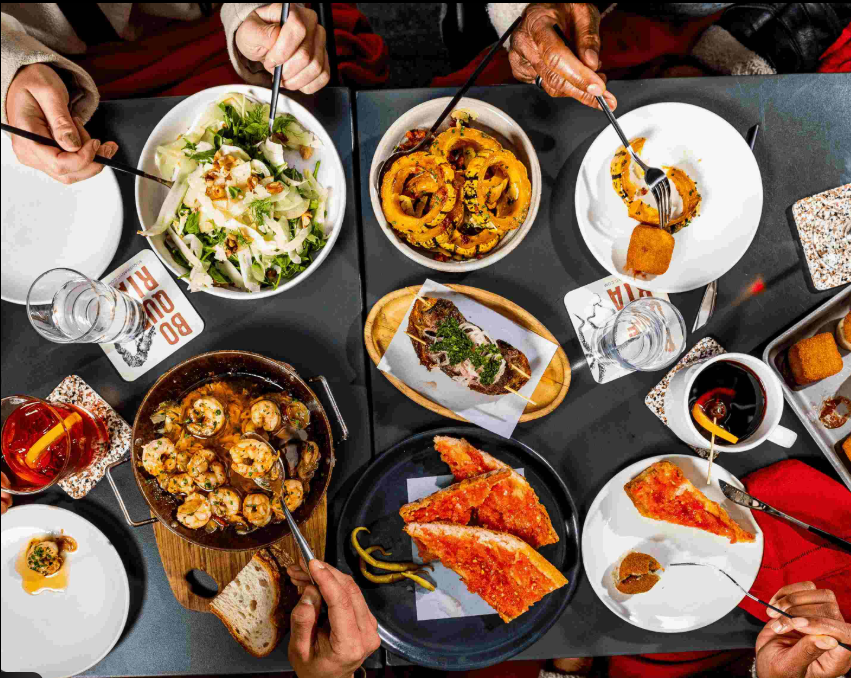
In Spain, tapas bars are neighborhood anchors. They’re charged with history and charging ahead at the same time. The counters are lined with plates—croquettes still warm, mushrooms waiting for the pan, cured anchovies glistening, skewers ready for the grill.
You don’t commit to the whole night at once.
You commit one bite at a time.
That’s the difference.
The Crawl
In places like Barcelona and San Sebastián, you rarely stay in one spot.
You start somewhere. A couple of montados—olive oil toasts topped with whatever the market looked best that morning. Maybe a slice of tortilla. Maybe a few blistered Padrón peppers, one of them sharp enough to surprise you.
Then you move.
Another bar. Another drink. Another specialty.
This rhythm creates something a traditional sit-down meal rarely does: constant momentum. Conversation resets. Energy shifts. The night builds gradually.
It’s social by design.
Small Plates, Big Flavor
Tapas are small, but they are not subtle.
Patatas bravas crackle and carry heat. Gambas al ajillo arrive snapping in garlic and chile. Jamón Ibérico melts into sweetness and salt. Paella finishes with socarrat—the caramelized crust at the bottom of the pan that everyone reaches for.
Because portions are smaller, flavors can be bolder. You don’t need to temper a dish for forty bites. You need to make it count for four.
Each plate should stand alone.
Each plate should stand out.
Why It Works
Sharing changes everything.
“I’ll fight you for that last squid.”
“Mind if I soak up the sauce?”
“What’s in that?”
Food sparks conversation. Conversation sparks connection. It’s informal, genuine, immediate.
That’s why tapas bars are loud. That’s why the music rises as the room fills. That’s why you always end up ordering one more thing.
It’s not about quantity.
It’s about rhythm.
Tapas, Stateside
When tapas travel from Spain to the United States, the format stays intact. The energy stays intact. What shifts is the tempo.
A little more heat. A little more contrast. The same respect for product.
Pan con tomate remains simple and correct. Croquetas must shatter before they melt. Lamb skewers need smoke and brightness. Cocktails keep pace with the plates.
Tapas don’t need reinvention.
They need execution.
Small plates. Big flavor. Built for sharing. Designed for nights that stretch longer than planned.
That’s tapas.
And once you understand that, you understand why one plate is never enough.